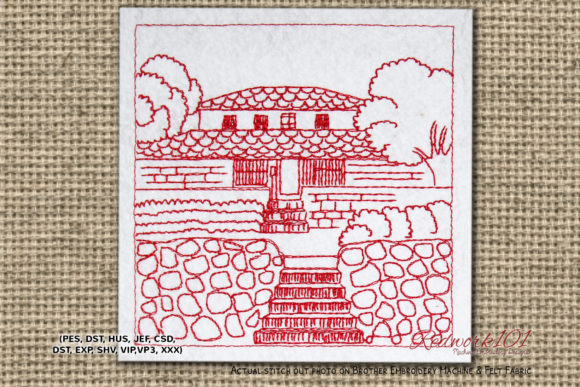
Indian House Village Redwork: A Designer’s Review for Small Business Merch
As an embroidery designer who has worked with hundreds of commercial and small business clients, I’ve learned that not every machine embroidery design translates well from the digital file to the finished product. Indian House Village Redwork caught my attention immediately because it balances a classic, hand-drawn feel with the clean repeatability that modern embroidery machines demand. Whether you’re a café owner wanting aprons or an Etsy seller building a cohesive brand, this design deserves a close look. I’ll break down exactly how it performs in real business use, where it needs extra care, and how it can elevate your brand identity.
First Impressions: Rustic Charm with Professional Polish
The first thing I noticed about Indian House Village Redwork is the name itself — “Redwork” traditionally refers to single-color embroidery done in red thread, often with a nostalgic, folk-art quality. The design appears to capture a cozy, village scene with a distinctly handmade feel. The optional Box Stitch adds a framing element that can turn a simple patch into a structured badge. For small businesses, this means you get two looks in one file: a freeform, artistic version without the box, or a clean, contained lockup with it. The outer box color being different from the design (unless it’s part of the design) is a detail that gives you flexibility — you can match the box to your brand color while keeping the inner redwork authentic. Overall, the impression is friendly, rustic, and premium, like something you’d see on a farm-to-table restaurant’s takeout bag or a boutique’s cloth shopping tote.
Real-World Performance: Patches, Apparel, and Branded Merchandise
Let’s talk about how Indian House Village Redwork holds up across the most common business uses. In my experience testing redwork designs, the single-color nature is a huge advantage for small businesses — it reduces thread changes, keeps production fast, and ensures consistency across all items.
- Embroidered patches. This design is ideal for custom patches. The village motif works well as a patch on a canvas tote bag, a denim jacket, or a cap. The optional box stitch can act as a border, giving the patch a finished edge that mimics a woven label. If you’re producing patches for a local bookstore or a handmade soap brand, the rustic charm will stand out.
- Staff uniforms and aprons. For a café or bakery, this design placed on the chest of an apron or a work shirt says “handcrafted and community-focused.” The redwork style doesn’t scream corporate; it whispers “we care about details.” I’ve seen similar designs used by florists and pet brands with great success.
- Cap embroidery. Caps are tricky because of the curved surface. The open, village-style composition (with buildings, trees, and paths) needs to be tested at cap size. If the design is too dense, it can distort. But if the file is digitized correctly, the redwork lines can flow naturally with the cap’s curve.
- Tote bags and product labels. Tote bags are a staple for small business merch. Indian House Village Redwork applied as a tote bag design adds perceived value. Customers will reuse the bag, giving you ongoing brand exposure. It also works as a small product label — think of it as a sew-on tag for handmade candles or jam jars.
For commercial embroidery projects, this design can be repeated across different items (caps, aprons, totes) to create a consistent visual language. The embroidery file itself is the foundation; make sure you have the right format for your machine.
Where to Use Carefully: Size, Curves, and Fabric Constraints
No design is perfect for every scenario. Here’s where Indian House Village Redwork requires extra attention from a designer’s perspective.
- Small patch sizes. If you plan to use this design as a tiny chest logo (say, 2 inches wide), the intricate village details may become muddy. The buildings, trees, and pathways need enough space to remain legible. I recommend testing the design at your target size before committing to production. If the optional Box Stitch is included, it can eat into the available space — consider using it only for larger applications.
- Cap fronts and curved surfaces. The curve of a cap can distort the perspective of a village scene. Work with a digitizer who understands how to split the design for a curved surface or adjust the layout to fit a cap front. The redwork lines are relatively thin, so they handle curvature better than dense fills, but the overall composition may shift.
- High stitch density from the box stitch. The optional Box Stitch, if used, adds a border that can increase stitch density significantly. This can cause puckering on lightweight fabrics. Always test on a scrap piece of your actual fabric. If the fabric is a stretchy knit or a fine woven, consider dropping the box stitch to keep the design light.
- Dark uniforms and frequent washing. Redwork traditionally uses red thread, which can fade over time with repeated washing. For staff uniforms that see heavy use, choose a high-quality thread with good colorfastness. Alternatively, you can use a different color for the redwork (like a dark navy or charcoal) to maintain contrast and longevity. The design’s simplicity means it will still look good even after some wear — a distressed look can actually add to the rustic appeal.
Brand Identity Impact: Building Trust Through Consistent Embroidery
When a customer sees a consistent embroidered patch or apron embroidery on a small business’s staff, it builds brand identity and customer trust. Indian House Village Redwork has a distinct personality that can help you stand out. It’s not a generic corporate logo; it feels like a story. For a handmade product brand, this design can be the visual anchor that ties together your packaging, your website, and your physical merchandise.
The finished product with this design looks like it was made with care. That perception directly increases the product value in the customer’s eyes. A tote bag with a generic print might be tossed aside, but one with a high-quality embroidered patch becomes a keepsake. For Etsy sellers and craft business assets, this design can be a signature element that buyers recognize. The visual consistency across caps, aprons, and bags reinforces your brand every time someone uses the item.
However, make sure the design aligns with your brand’s voice. If your business is a sleek, modern tech startup, the rustic village scene might feel mismatched. But for a creative studio, a bakery, a florist, or a pet brand with a cozy, handmade ethos, it’s a perfect fit. The handmade presentation of redwork embroidery conveys authenticity, which is a powerful driver of buyer engagement.
Practical Notes from an Embroidery Designer
Before you rush to stitch out Indian House Village Redwork on your entire merch line, here are my professional recommendations based on years of working with machine embroidery design files.
- Test it in black and white first. Always run a test stitchout using a neutral thread color (like black or white) to check the design’s structure, spacing, and any potential issues. This is especially important for digital embroidery file purchases where you haven’t seen the physical result.
- Check if it works at small patch size. As mentioned, the village details need space. If you’re aiming for a 2-inch patch, ask the digitizer or supplier if they can simplify the design or remove the box stitch to maintain clarity.
- Review thread color contrast. Red on a light background is classic, but also test it on the fabric you’ll use. If your uniform is a dark navy or black, the red might not pop enough. Consider a contrasting thread color — white or gold on dark fabric can look stunning.
- Inspect spacing and stitch density. The description says the Box Stitch is optional and often a different color. If you include it, ensure the stitch density is not too high for your fabric. Use a stabilizer appropriate for the fabric type — a tear-away for stable wovens, a cut-away for knits or caps.
- Confirm hoop size. Before committing to a production run, verify that the design fits your hoop size. If you’re using a multi-needle machine, you can easily hoop multiple items, but for single-needle home machines, you may need to re-hoop for each piece.
- Test on real fabric. Don’t rely on a digital mockup alone. Stitch out the design on the exact fabric you plan to use for your custom apparel or patches. This will reveal any distortion, puckering, or thread breakage issues.
- Create a mockup for client approval. If you’re a product designer or embroiderer working with a client, use a printable mockup to show how Indian House Village Redwork will look on a cap, apron, or tote bag. This helps manage expectations and avoids costly rework.
- Compare it beside other design assets. If you already have a logo or other design assets, stitch this design next to them to see how they harmonize. Consistency in style is key for a strong brand.
- Confirm commercial licensing before business use. This is critical. The product description doesn’t specify license terms, so you must check with the seller whether the embroidery file can be used for commercial embroidery — selling finished products, producing patches for resale, etc. Never assume.
In summary, Indian House Village Redwork is a versatile, charming design that can elevate your small business merchandise when used thoughtfully. It shines on patches, aprons, totes, and caps, provided you respect its size limitations and fabric requirements. As a designer, I appreciate when a digital file offers the flexibility of an optional box stitch and a proven redwork style. If you’re in the Cities category of designs, this village scene fits perfectly. And as an Embroidery product, it delivers the handmade quality that small businesses need to build trust and recognition. Test it, tweak it, and let it become a signature element of your brand.